 Tours From Baku
 EN
EN  RU
RU  AR
AR  HE
HE  DE
DE  ZH
ZH 
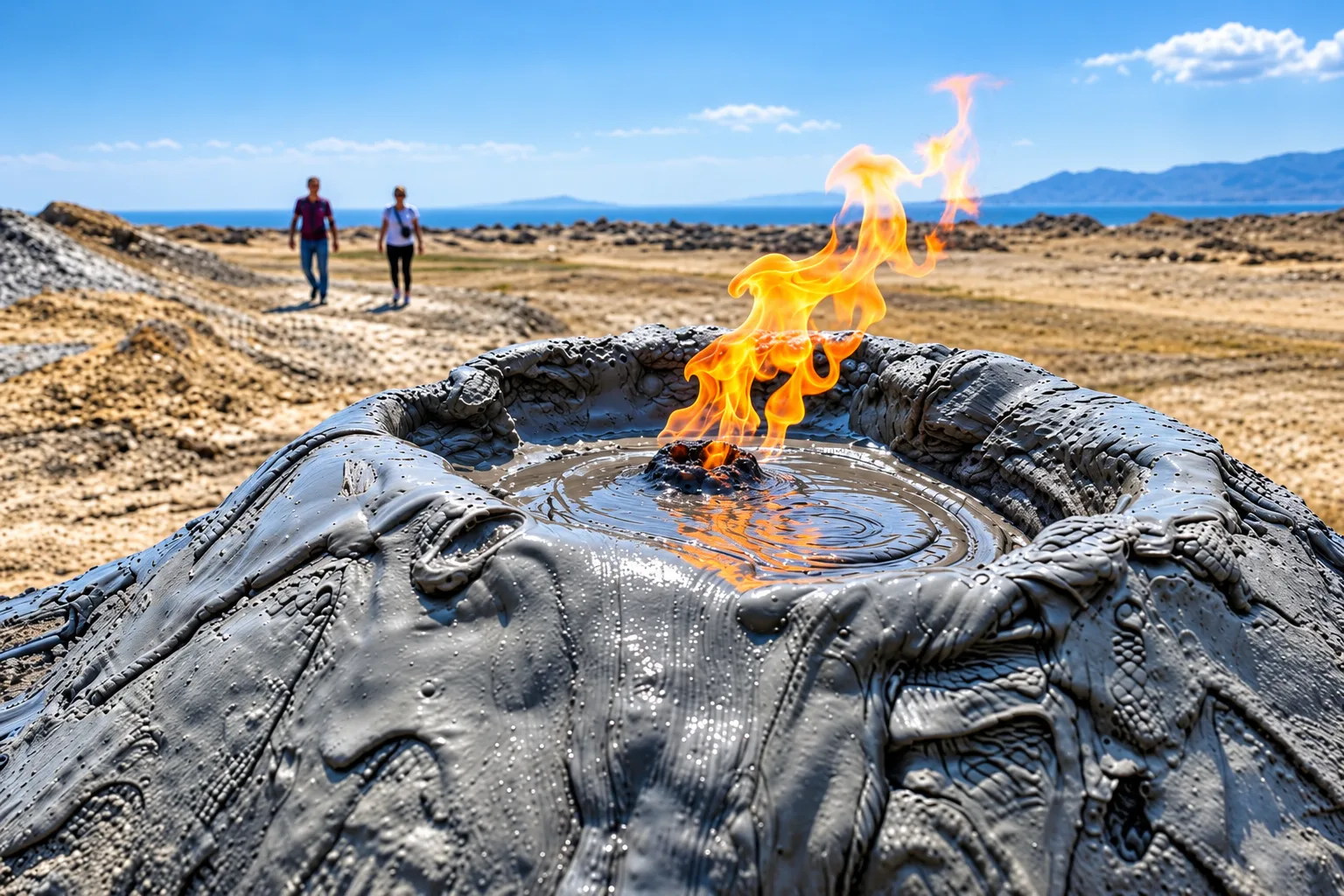
Yanar Dag is a low hillside on the Absheron peninsula with a strip of flame along its base, fed by natural gas coming out of the ground on its own. It has been burning continuously for decades. That is the whole of it, and knowing that in advance is most of what makes the visit good rather than disappointing.
This is not a tour page. It is the practical brief: how long you need, when to go, what else is on the site now, and whether it deserves a trip by itself.
It is smaller than the photographs suggest
Photographs of Yanar Dag are taken close, at night, with a long exposure. In daylight you are looking at a band of fire perhaps ten metres long against a rock face, with a viewing terrace in front of it and the wind pushing the flames flat.
That sounds like a criticism and is not one. The thing is genuinely strange — gas that has been leaving this ground and burning since before anyone thought to charge for it, in the country that took its name from exactly this. But it is a twenty-minute thing, not a two-hour one, and people who arrive expecting a landscape are the ones who leave unimpressed.
The timing problem
Here is the part worth planning around, and it comes from two facts that nobody puts next to each other.
The first: fire is only spectacular in the dark. In daylight the flames are pale and thin; after sunset the same flames are the photograph you came for.
The second: the reserve's own site gives its hours as every day, 10:00 to 19:00.
Put those together and the summer is ruled out. Baku in June does not get dark by seven, so between roughly April and September you will see it in daylight whatever time you arrive. In late autumn and winter, when the sun is down well before the gate closes, a late-afternoon visit gets you the version that is worth the trip.
If you are here in summer and the flame at night is what you want, that is worth knowing before you build a day around it rather than after.
What is there besides the flame
More than there used to be. The reserve now has an indoor museum with digital and art installations, and an open-air exhibition of cromlech stones. That is what turns a twenty-minute stop into something closer to an hour, and it is also the part that works in daylight and in bad weather.
It matters for one practical reason: the flame does not care about rain, but you will, and the museum is the difference between a wasted drive and a reasonable one on a wet afternoon.
Where it is, and how people actually get there
The reserve is in the village of Mammadli, on the Absheron peninsula — close to the city rather than out of it. For scale, our car between Baku and Absheron covers 35 km in about 40 minutes.
Almost nobody goes to Yanar Dag alone, and they are right not to. The peninsula is full of things that are each too small to be a day and together make a good half: our Absheron half day is 4–5 hours for ₼50 and covers Ramana castle, the painted oil village at Balakhani and the burning hill. If you would rather have the fire sites as part of a bigger day, the Gobustan day is 8 hours for ₼29 and takes in Ateshgah and Yanardag on the way back from the rock carvings and the mud volcanoes.
Going under your own steam is perfectly possible too. The thing to get right is not the route but the return — it is a village, not a transport hub.
Tickets
There is an entrance fee, and we are not going to print a figure for it. The reserve's own website does not publish one; the numbers circulating in travel articles come from no official source and are exactly the kind of thing that changes and then gets quoted back at a ticket window by somebody who read it here.
Check the reserve's own site or the state ticketing system on the day. It is a small amount either way, and it is not the part of this trip worth optimising.
Is it worth going?
Yes, with the expectations set above: as part of an Absheron afternoon rather than as a destination, in the colder half of the year if you can choose, and with an hour rather than twenty minutes allowed now that the museum is there.
No, if you are choosing between this and Gobustan on a single free day. Gobustan is the bigger thing by some distance, and the day that goes there passes the fire sites anyway.
Frequently asked questions
What are Yanar Dag's opening hours?
The reserve's own site gives them as every day, 10:00 to 19:00. Since it closes at 19:00, the flame is only seen properly in the dark during the months when sunset comes early.
How long do you need at Yanar Dag?
The flame itself is twenty minutes. With the indoor museum and the cromlech stone exhibition, allow about an hour.
Where is Yanar Dag?
In the village of Mammadli on the Absheron peninsula, close to Baku. For scale, a car between Baku and Absheron covers 35 km in about 40 minutes.
How much does it cost to enter Yanar Dag?
There is a fee, but the reserve does not publish it on its own site and we will not repeat a figure we cannot source. Check the reserve's site or the state ticketing system before you go.
Is Yanar Dag worth visiting?
As part of a half day on the Absheron peninsula, yes. As a trip of its own from Baku, it is a lot of driving for one short thing — and if your free day is a choice between this and Gobustan, take Gobustan, which passes the fire sites on the way back anyway.
Can you see Yanar Dag at night?
Only when sunset falls before the 19:00 closing time, which rules out most of the summer. In late autumn and winter a late-afternoon visit gets you the flame in the dark.
The opening hours, the location and the description of the museum and cromlech exhibition come from the reserve's own website, read on 23 September 2026. Hours change seasonally in many places and this one may too — check before building a day around the light. Our own durations and prices are verified against our catalogue whenever this page is built.
Around it
If you are working out what fits an afternoon rather than a full day, half a day in Baku sorts the short trips by the clock. If the fire sites are on your list because of the UNESCO label, every UNESCO site in Azerbaijan explains which of them actually carry it and which are on the tentative list.
Want to see it for yourself?
The trips above are run from Baku by our team: guides who speak English and Russian, a group of up to eighteen or a private car, and free cancellation up to 24 hours before a day trip.
Comments
No comments yet.
Be the first to share your thoughts!
Leave a Comment